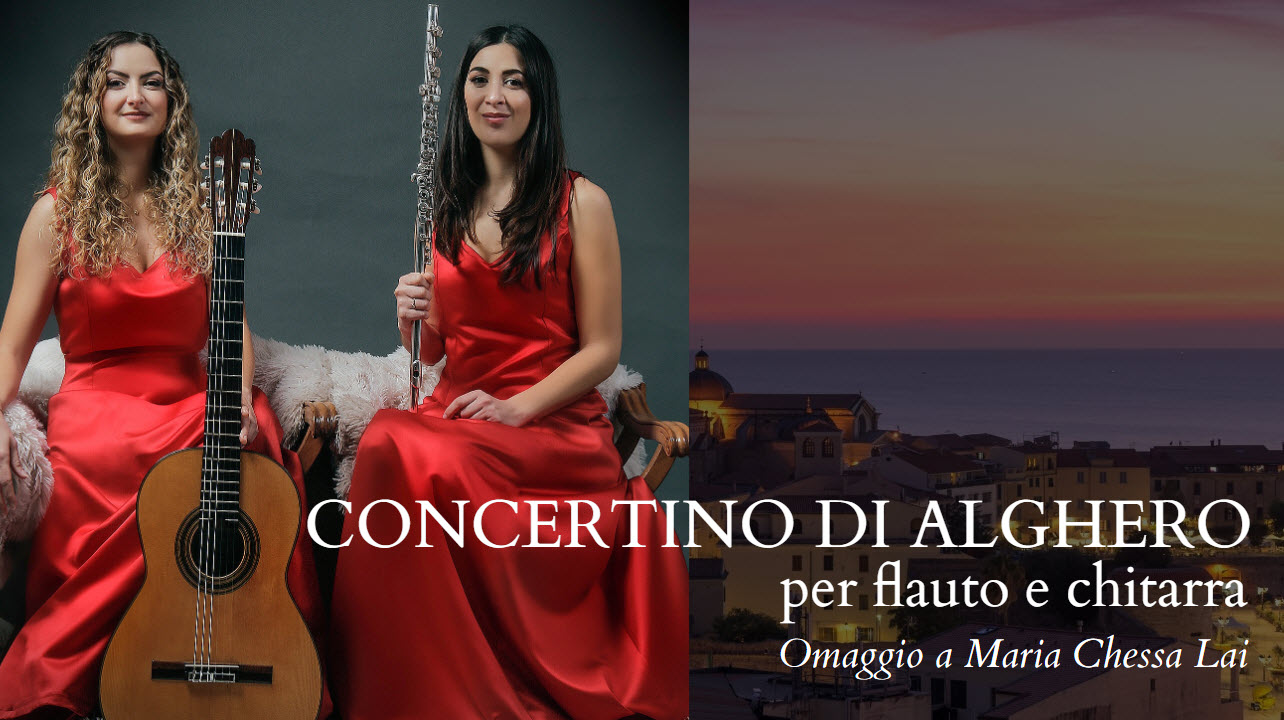
Concertino di Alghero per flauto e chitarra

Concertino di Alghero per flauto e chitarra

Ho iniziato a scrivere il Concertino di Alghero per flauto e chitarra su un volo aereo, al rientro da Madrid dove Francesca Apeddu (flautista) e Maria Luciani (chitarrista) del Cordas et Bentu Duo avevano appena eseguito la prima assoluta di "Janas - Poemetto per Flauto e Chitarra", una composizione a loro dedicata nell'ambito della manifestazione internazionale Sardinia_Moving_Arts®


Strutturato in tre movimenti, il Concertino di Alghero traccia il profilo musicale di una delle tante possibili letture di En Dins De Mi della poetessa algherese Maria Chessa Lai (1922-2012)


Il primo movimento Contas de Dolças Rondallas (trad.: leggende di dolci favole) è una leyenda che fa uso di due temi principali la cui elaborazione si intreccia in modo continuo tra i due strumenti attraverso l’osservazione prismatica delle cellule fondamentali. Il breve episodio prima della ripresa pur non rinunciando alle elaborazioni dei temi principali e sviluppandosi su un tappeto ritmicamente immobile, assume le sembianze di un soggetto celato, scoperto come spostando per pochi attimi l’attenzione dalla scena principale al contesto in secondo piano.


Il secondo movimento En l’Alba Clara (trad.: Nell’alba chiara) non abbandona del tutto l’ambiente tonale del primo, ma evocando i giochi e le infinite cromature delle primissime luci dell’alba, si muove su cromatismi ondulanti privi di qualsiasi staticità che danno origine a tre brevi episodi.


Nel movimento finale Les Fulles més no Tremolen (trad.: Le foglie più non tremano) l’impeto sopito dell’immaginaria osservatrice di una porzione di quiete esistenziale, è messo in primo piano dall’andamento rutilante marcato a fuoco fin dalle primissime battute. Il dialogo serrato tra i due strumenti e le ampie escursioni dinamiche si amalgamano dando forma ad una pasta sonora dalla quale i richiami dei temi passati sono come estratti da una memoria perduta.

Le due artiste hanno incluso la registrazione del brano nel loro progetto discografico Tales from Sardinia grazie ad un importante contratto discografico firmato con la casa olandese Brilliant Classics pochi mesi fa.


Qui, in anteprima, sono felice di pubblicare per i lettori del blog, la registrazione del brano.

I began writing the Concertino di Alghero for flute and guitar on an airplane, on my way back from Madrid, where Francesca Apeddu (flutist) and Maria Luciani (guitarist) of the Cordas et Bentu Duo had just premiered Janas – Poemetto per Flauto e Chitarra, a composition dedicated to them as part of the international event Sardinia_Moving_Arts®.

Structured in three movements, the Concertino di Alghero outlines the musical profile of one of the many possible readings of En Dins De Mi by the Algherese poet Maria Chessa Lai (1922–2012).


The first movement, Contas de Dolças Rondallas (lit.: tales of sweet legends), is a leyenda built on two main themes whose elaboration intertwines continuously between the two instruments through a prismatic exploration of their fundamental cells. The brief episode before the reprise, while still drawing on the elaboration of the main themes and unfolding over a rhythmically static backdrop, takes on the appearance of a hidden subject — revealed as if shifting one’s attention for a moment from the main scene to the background.


The second movement, En l’Alba Clara (lit.: In the clear dawn), does not entirely abandon the tonal environment of the first. Evoking the play and infinite hues of the earliest dawn light, it moves through undulating chromaticisms devoid of any sense of stasis, giving rise to three short episodes.


In the final movement, Les Fulles més no Tremolen (lit.: The leaves tremble no more), the subdued impulse of an imaginary observer contemplating a fragment of existential quiet is brought to the foreground by the swirling, incisive motion established from the very first bars. The tight dialogue between the two instruments and the wide dynamic range blend together to form a sonic texture from which echoes of past themes emerge as if drawn from a lost memory.

The two artists have included the recording of the piece in their album project Tales from Sardinia, thanks to an important recording contract signed a few months ago with the Dutch label Brilliant Classics.


Here, as a preview, I am pleased to share with the readers of the blog the recording of the piece.